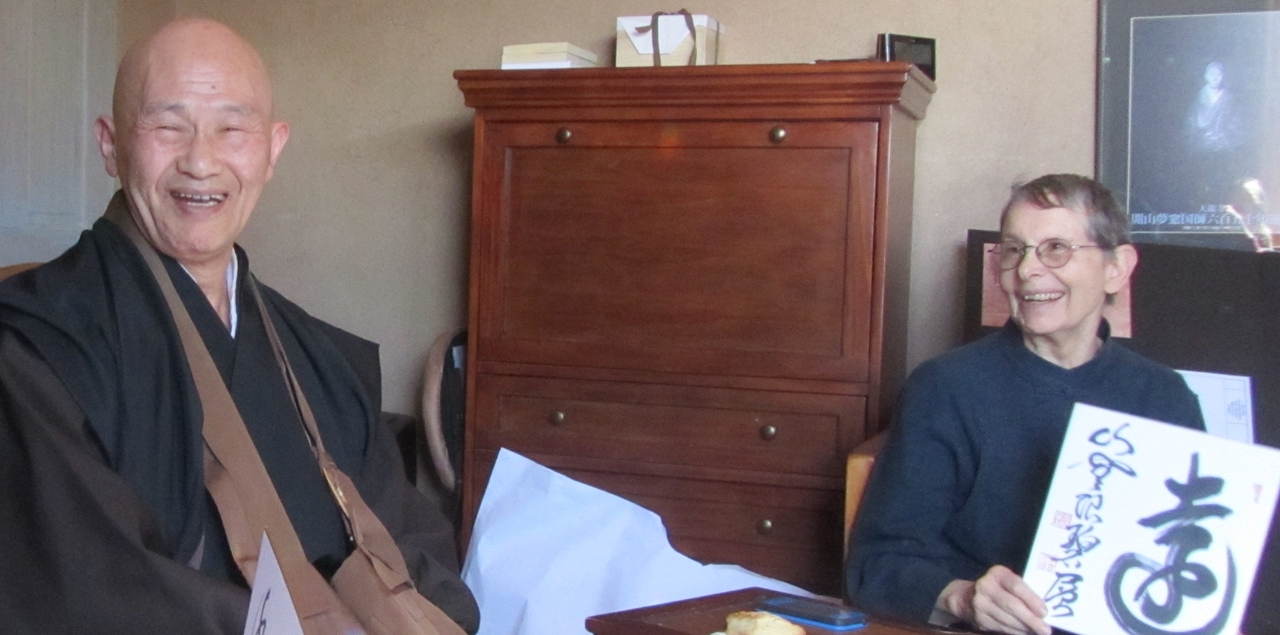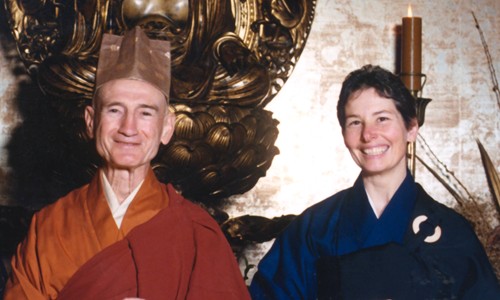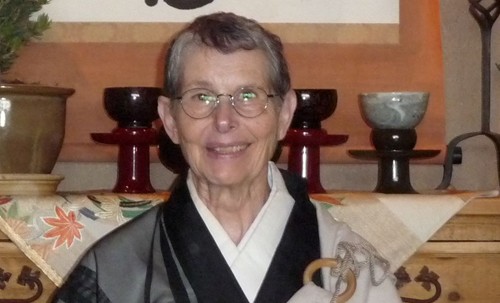
MITRA BISHOP ROSHI is the founder of Mountain Gate-Sanmonji. She first encountered the practice of Buddhism while living in Asia and began practicing Zen in January 1, 1974 while living in Turkey. From 1976 on she trained full-time at the Rochester Zen Center under Roshi Philip Kapleau. Mitra received Jukai (the ceremony of taking the Buddhist Precepts) in the late 1970s and was ordained as a Zen Buddhist priest in 1986. She was given the name “Mitra,” which translates to “spiritual friend.”
After completing 20 years of intensive meditation, she chose to continue her training at a Japanese monastery, Sogen-ji, in Okayama, Japan. In 1996 she returned briefly to Rochester Zen Center and underwent the formal ceremony in which Roshi Kapleau authorized her to establish her own Zen Buddhist center. In that same year she was asked to go to Hidden Valley Zen Center in San Marcos, California to guide the Sangha (community of Zen Buddhist meditators) there. Concurrently, she established Mountain Gate as a monastic practice center in the mountains of Northern New Mexico.
Mitra-roshi received a B.A. from Indiana University, and worked in graphic, interior, and architectural design for many years. Her final work in that line was for an HVAC engineer designing heating and cooling systems for buildings. This personal history served her well in designing the first buildings at Mountain Gate.
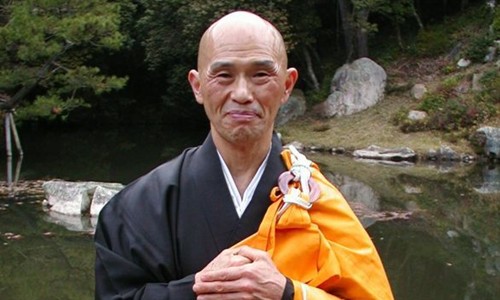
Taking to heart the admonition, “There’s no beginning to enlightenment, no end to practice, no beginning to practice, no end to enlightenment,” she continues to train intensively with Harada-roshi, abbot of Sogen-ji where she trained in residence for many years.
Before the Covid pandemic, Mitra-roshi would travel to other locations, including the Hidden Valley Zen Center in southern California and Turtleback Zendo in New Jersey to offer guidance in sanzen (one-on-one personal guidance from teacher to student) and lead sesshin and other Dharma teachings based on the traditional guidance of the Buddha. It’s important to note that Buddhists do not worship the Buddha, but do revere the teachings of the original man who became the Buddha. Since the Covid pandemic, out of state students tune in to Mountain Gate via Zoom to attend sesshin and receive spiritual guidance. On November 14, 2025, Sozui Stephanie Schubert took over Hidden Valley Zen Center as the successor of Harada-Shodo Roshi.
Mitra-roshi is an accomplished calligrapher whose works hang in Zen temples. At this point, however, her eyesight has deteriorated to the point where she can no longer do calligraphy. She still writes for the digital-only, free quarterly publication, The Mountain Gate Journal. If you would like to have a subscription to the Journal, which includes the current sesshin schedule, refer to the “Resources” tab in this website.
Mitra-roshi’s writings have also appeared in the book Mu, edited by James Ford and Melissa Blacker, in Kenneth Kraft’s, Zen Teaching, Zen Practice, in Blossoms of the Dharma, edited by Thubten Chodron and Sylvia Boorstein, and in Record of the Hidden Lamp. She has also written for the website Sweeping Zen and for Buddhadharma Magazine. She has most recently written two books on intensive Zen training, Deepening Zen: the Long Maturation, Book 1 and Deepening Zen: the Long Maturation, Book 2.
Mitra-roshi has two children, three grandchildren, and three great-grandchildren.